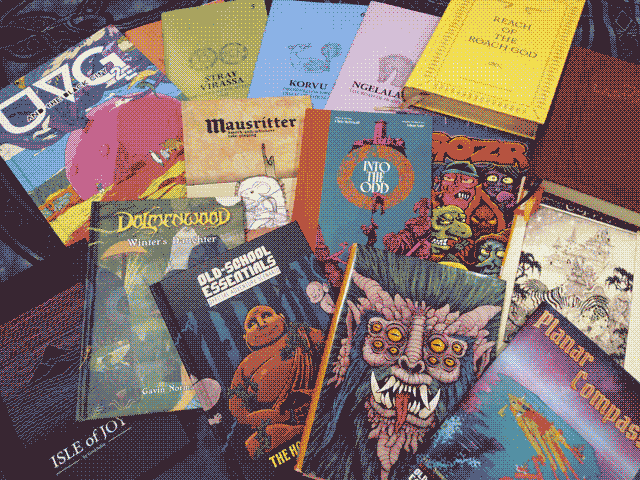
The Old School Renaissance (or Revolution, or Revival) is a style of play and design in RPGs which harks back to the D&D of the 1970s.
To many people this just means grognards and dungeon crawls, with no roleplaying to speak of. This isn’t accurate. While there is an emphasis on dungeon crawling, challenge and lethality in many OSR campaigns, the core philosophy is more one of player agency. If I had to sum it up:
(These principles are explored in more depth in the pretentiously named Principia Apocrypha.)
In fact, combat itself is de-emphasised; one phrase that goes around the OSR community is “combat as a fail state”. Which is to say, when you’re a first level wizard with 2hp you might want to talk with those goblins or distract them, because a fight with them could go south very quickly.
There’s often no reward for fighting, with all XP granted for treasure and quest success - if you can get the job done without swinging a sword, good for you! The system won’t penalise you.
Most encounters in old school games begin with a reaction roll, with a significant chance of a reaction that isn’t immediately hostile.
So it’s better to understand the OSR style as a kind of ‘D&D unplugged’ with less reliance on scripted events, preplanned adventures, and special abilities.
But to me personally, the OSR is, above all, about unlocking creative potential.
The rules get out of the way and let you play. Because it’s easy to run a simple dungeon crawl looking for treasure, we very quickly come up against the boundaries of that style of play, and start asking questions like “why are you venturing into the dungeon in the first place?”, “what are you going to do with all that treasure?”
Before long my game became about epic arcs of romance and revenge, faith, politics, nation-building, the exploration of other worlds, finding a beautiful corner of the world and protecting it at all costs, community, weird science, destiny... in other words, everything except dying in a hole trying to rob a goblin.
It was easy to get there because the rules were quick and easy. We could run more than two combats per night. If someone wanted to play a weird class, I could make it up on the spot. If someone was playing a living statue or a ghost they could walk on the sea bed with mermaids because that’s just how it works, without having to worry about whether letting them breathe underwater is ‘unbalanced.’
The scene has also produced some of the most creative works of game and adventure design I’ve ever seen. The Thousand Thousand Islands series by Mun Kao and Zedeck Siew presents a unique Southeast Asian fantasy world, a river-kingdom ruled by crocodiles, a city with a phantom upper storey inhabited by ghosts, which only appears when it rains; holy cats and haunted woods.
Through Ultan’s Door by Ben Laurence opens the way to a world of opulent fantasy with the dreamlike wonder of Lord Dunsany and the cynical, decadent style of Clark Ashton Smith. You can travel to a world of dreams and flee from cruel puppets on the banks of the Great Sewer River before venturing up into the windy, twisted city of Zyan Above or down to the fungal white jungle hanging perilously from the base of the island as it floats on a sea of dreams.
The Bastionland series of Chris McDowell (Mythic Bastionland, Into the Odd, Electric Bastionland) offers myth-haunted arthurian hexcrawls as well as industrial horror and weirdness in the Only City That Matters.
Mork Borg, by Pelle Nilsson and Johan Nohr, is a heavy metal album of a game, gritty fantasy at the end of the world.
From the pen of artist Luka Rejec, Ultraviolet Grasslands and the Black City takes us far beyond the apocalypse, billions of years into the future on a caravan trip through a strange, moebius-style future toward the setting sun and the eponymous city where all wishes can be granted.
Dolmenwood by Gavin Norman offers a lavish and dark world of British folklore with enough material to play for years.
GOZR by J. V. West is a hand-drawn game of weird little guys evoking underground comics, heavy metal and the work of Vaughn Bodē.
Isaac Williams’ precious and perilous Mausritter casts you as a little mouse with a button for a shield and a sewing needle sword, building up your tiny community, fighting snakes and seeking the counsel of owls (who are hopefully not hungry.)
This is why the OSR appeals to me. I’m not interested in high lethality games or challenging the players, Gygax style. I want roleplay. I want story. I want wonder.
As Smith wrote in his gloriously florid prose-poem To the Daemon:
Tell me many tales, O benign maleficent daemon, but tell me none that I have ever heard or have even dreamt of otherwise than obscurely or infrequently. Nay, tell me not of anything that lies between the bourns of time or the limits of space: for I am a little weary of all recorded years and charted lands; and the isles that are westward of Cathay, and the sunset realms of Ind, are not remote enough to be made the abiding-place of my conceptions; and Atlantis is over-new for my thoughts to sojourn there, and Mu itself has gazed upon the sun in aeons that are too recent,
Tell me many tales, but let them be of things that are past the lore of legend and of which there are no myths in our world or any world adjoining. Tell me, if you will, of the years when the moon was young, with siren-rippled seas and mountains that were zoned with flowers from base to summit; tell me of the planets gray with eld, of the worlds whereon no mortal astronomer has ever looked, and whose mystic heavens and horizons have given pause to visionaries. Tell me of the vaster blossoms within whose cradling chalices a woman could sleep; of the seas of fire that beat on strands of ever-during ice; of perfumes that can give eternal slumber in a breath; of eyeless titans that dwell in Uranus, and beings that wander in the green light of the twin suns of azure and orange. Tell me tales of inconceivable fear and unimaginable love, in orbs whereto our sun is a nameless star, or unto which its rays have never reached.
And wonder is what the scene provides, on a level you won’t find in Absalom or Waterdeep.